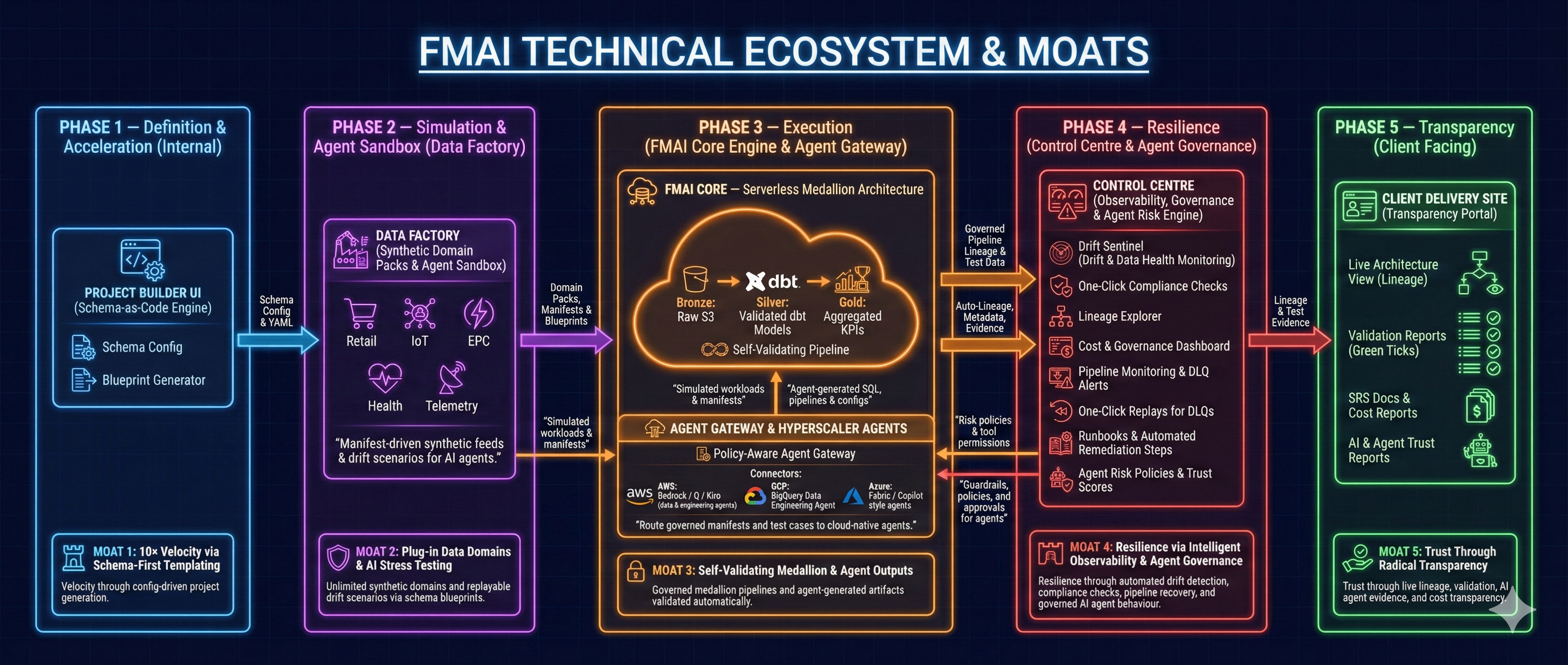
Fast Medallion AI (FMAI) v2.0
FMAI is a Governance & Simulation Layer for Hyperscaler Agents.
While Hyperscaler Agents (like AWS Bedrock or Google Vertex AI) can generate code and pipelines, they lack inherent context, safety, and business alignment. FMAI provides the "Guardrails & Proving Ground" required to deploy agent-generated data solutions with confidence.
It connects Operations Teams with AI Agents through a control plane that enforces: 1. Simulation: Every agent output is sandboxed and tested against synthetic data before deployment. 2. Governance: Full audit trails of prompts, tokens, PII redaction, and costs. 3. Trust: Cryptographically signed "Trust Reports" that prove a solution works.
5-Layer Governance Model
FMAI implements a verified chain of custody for AI-generated assets:
1. The Manifest Gate
Every data product starts with a Manifest—a single YAML configuration defined by a human. - Schema Validation: Ensures requests match capabilities. - Version History: All changes to the "ask" are tracked (GitOps for Agents).
2. Metadata & Cadence Controls
FMAI manages the "heartbeat" of the data platform. - Cadence Management: Scheduling agent runs (e.g., Hourly, Daily). - Behavior Templates: Defining how agents should react to missing data or schema drift.
3. Agent Governance & Redaction
Before a prompt reaches the Hyperscaler (Bedrock/Vertex):
- PII Redaction: Fields tagged semantic:pii are automatically masked.
- Prompt Logging: Full audit of the input context and the raw model response.
- Cost Controls: Token counters prevent "runaway" agent loops.
4. Simulation Enforcement (The "Sandbox")
Agent-generated code (SQL, Terraform, Python) is never deployed directly. It is first routed to the Simulator, which: - Spins up ephemeral infrastructure. - Injects synthetic data (using FMAI's "Data Factory" behaviors). - Measures Schema Drift and Anomaly Detection.
5. Transparency & Trust Reports
The final deliverable is not just code, but a Trust Report: - Signed Evidence: A PDF/JSON bundle containing the manifest, the simulation logs, and the approval timestamp. - Cost Summary: Exact token cost for that specific feature build.
Orchestration Flow
The following sequence highlights the interaction between the Human Operator, the Governance Layer, and the AI Agent.
sequenceDiagram
    participant Ops as Operations Team
    participant AG as Agent Gateway
    participant HA as Hyperscaler Agent
    participant Sim as FMAI Simulator
    participant Gov as Governance Log
    participant Client as Client Portal

    Ops->>AG: 1. Send Manifest (Scope)
    AG->>HA: 2. Invoke Agent (Sanitized)
    HA-->>AG: 3. Return Pipeline Proposal
    AG->>Gov: Log Prompts & Tokens
    AG->>Sim: 4. Stage & Simulate
    Sim-->>Ops: 5. Drift/Anomaly Results
    Ops->>Gov: 6. Approve (or Edit + Diff)
    Gov->>Client: 7. Publish Trust Report
Detailed System Components
1. Agent Gateway (The "Firewall for AI")
A lightweight, cloud-native service (Lambda/CloudRun) that wraps Hyperscaler SDKs.
- Role: It acts as the secure boundary for the system.
- Key Function: Enforces redaction tags (security:redact) before data leaves the environment.
- Observability: Logs 100% of prompt/response pairs to an immutable DynamoDB ledger for audit compliance.
2. The Control Centre
The central dashboard for Operations teams. - Simulation Panel: Visualizes real-time data flow, drift metrics, and anomaly scores during the "Proving" phase. - Approval Queue: A "Pull Request" style interface where humans review Agent proposals (SQL/Code). - Correction Loop: Operators can edit agent code directly. FMAI captures the Diff to fine-tune future prompts.
3. Data Factory (Simulator Engine)
The engine behind the simulation. It doesn't just generate random strings; it generates Data Behaviors. - Retail Scenarios: Simulates Point-of-Sale spikes, inventory drift, and customer churn signals. - IoT Scenarios: Simulates sensor failures, thermal runaways, and telemetry gaps. - Healthcare Scenarios: Generates PII-heavy claim updates to test redaction efficiency.
4. Client Delivery Portal
A read-only view for end-stakeholders. - Trust Reports: Access to the cryptographically signed PDFs proving system reliability. - Cost/Burn Dashboards: View project-level AI spend.
Component Readiness
| Component | Status | Notes |
|---|---|---|
| Manifest CLI | ✅ Mature | Schema validation & versioning active. |
| Simulator | ✅ Mature | Formerly "Data Factory"; proving drift flows. |
| Control Centre | 🔄 Updating | Adding new "Agent Governance" panels. |
| Agent Gateway | 🚧 In-Dev | Wrapping Bedrock/Vertex SDKs. |
| Trust Reports | 🚧 In-Dev | PDF/JSON signing pipelines. |
Deployment Models
FMAI is designed for Cloud-Native deployment with a "Bring Your Own Cloud" model:
- AWS Implementation:
- Compute: Lambda (Gateway), EventBridge (Cadence).
- Storage: DynamoDB (Governance Logs), S3 (Trust Reports).
- AI: Amazon Bedrock.
- GCP Implementation:
- Compute: Cloud Functions, Pub/Sub.
- Storage: BigQuery (Telemetry).
- AI: Vertex AI.
Portfolio Relevance
This project demonstrates leadership in Agentic AI Architecture, moving beyond simple "chatbots" to solving the hard problems of Enterprise AI Reliability: - System Design: Event-driven architecture for agent orchestration. - Safety Engineering: Implementing PII guards and cost controls. - Full-Stack Governance: From strict backend logs to transparent frontend "Trust Reports."